
Jaipur, January 20, 2026: A senior official in Jaipur has publicly raised concerns over prevailing class and caste bias in society after his young son was reportedly shunned by other children in the neighbourhood for playing with the son of a domestic worker. The incident has sparked conversation online and offline about deep-rooted social prejudices that continue to persist in residential communities.
The father, a Chief Executive Officer (CEO) of a company based in Jaipur, shared the experience on social media on January 18, 2026, urging society to introspect on how children in the city’s neighbourhoods are influenced by social status when forming friendships.
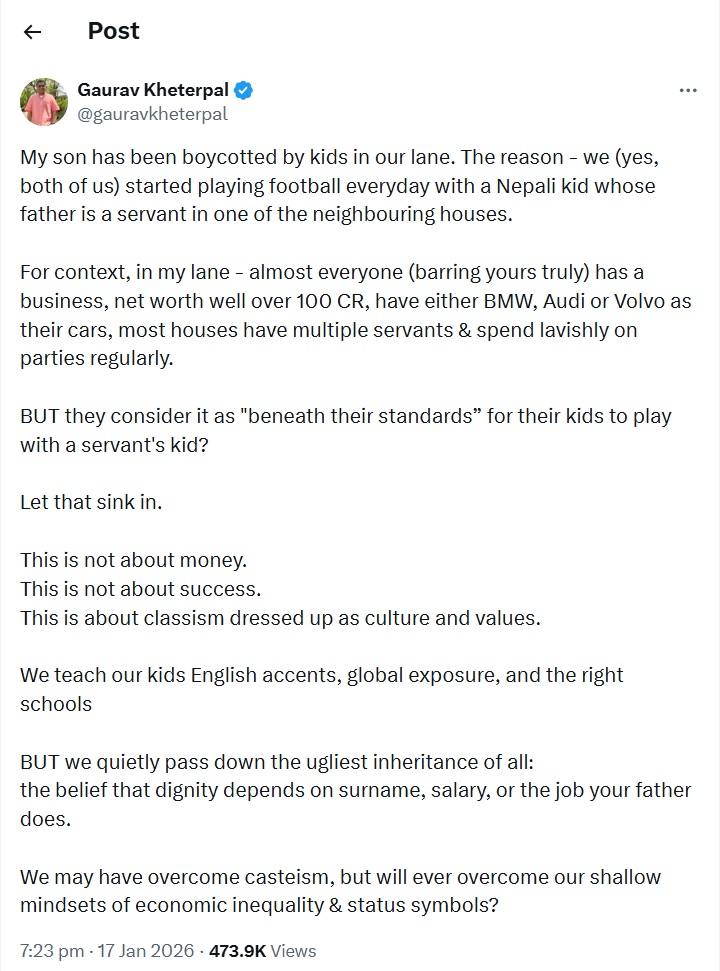
Incident and Social Media Post
According to the father, his son had become close friends with another boy whose parent works as a domestic helper in their residential colony. The children would often play together in common areas, sharing toys and laughter like any neighborhood friends.
However, the CEO claimed that other parents and children in the colony began to avoid his son after learning about the background of the friend from the domestic worker’s family. The children were “boycotted” and excluded from group play, leading the father to highlight that such behaviour stemmed from class lines and societal prejudices rather than simple childhood dynamics.
He posted about the incident on social media, stating that his intention was to call attention to subtle but persistent discrimination that still affects daily life, even in cosmopolitan cities like Jaipur.
Public Reactions and Debate
The post drew mixed reactions, with many netizens supporting his stance and applauding him for speaking up against social bias. Supporters emphasised how childhood friendships should be encouraged across socioeconomic backgrounds, and parents should avoid passing on prejudices to the next generation.
“Children learn from adults. If we teach them to see everyone as equals, they will grow up without unnecessary divisions,” one social media user commented.
Others in the online community argued that the situation might be more complex, involving innocuous childhood preferences rather than deliberate exclusion. Nonetheless, the broad public discussion underlined how social biases can manifest early and become entrenched if not addressed consciously.
Expert Views on Early Social Conditioning
Child psychologists note that early childhood experiences, including how parents discuss and model friendship and equality — can strongly shape children’s perceptions of others. When children notice differences in background, lifestyle or socioeconomic status, they often seek cues from adults on how to respond.
Experts suggest that encouraging inclusive behaviour, fostering empathy and celebrating diversity are essential parenting tools to counteract instinctive social segregation tendencies among young children.
A Mirror to Deeper Social Issues
The Jaipur incident has brought attention to how class bias and social hierarchies continue to influence interpersonal relationships beyond economic lines. While overt discrimination has decreased over time, implicit biases at the neighbourhood level can still affect children’s social circles and the way they form friendships.
Civil society activists welcomed the CEO’s candid account, saying it opens up a necessary conversation about societal attitudes that many choose to ignore.
“It should make all of us pause and reflect on how we talk about other people’s children, professions and backgrounds and what values we are passing on to our kids,” said a local social activist.
City’s Pulse and What Comes Next
In Jaipur, known for its rich heritage and vibrant community life, this story has sparked thoughtful debate in parent groups, schools and community forums. Some residents have acknowledged similar instances in other localities, while others have vowed to encourage more inclusive play and social interaction among children.
Local educators and school counsellors have also used the incident to highlight the importance of teaching inclusivity and anti-bias behaviour as part of early childhood education.
Whether this episode becomes a turning point for more conscious parenting and community engagement remains to be seen. However, it has undeniably put a spotlight on how even small social environments can reflect deeper societal attitudes that need careful and compassionate challenge.