
In 1857, the very year India’s first War of Independence erupted across the subcontinent, a Maharaja in Jaipur was quietly doing something remarkable: building a school for art. Not a palace, not a fort. A school. One that would go on to shape the artistic identity of an entire region for the next century and a half.
The Maharaja School of Arts and Crafts (today known as the Rajasthan School of Arts) is one of those institutions that sits so comfortably within the city’s fabric that it’s easy to overlook, until you stop and actually look at it. Housed in a magnificent 150-year-old haveli in Kishanpol Bazaar, within Jaipur’s UNESCO World Heritage Walled City, this building has played roles as a royal artist’s studio, a formal art college, and now a heritage museum. Every avatar has left its mark on the walls.
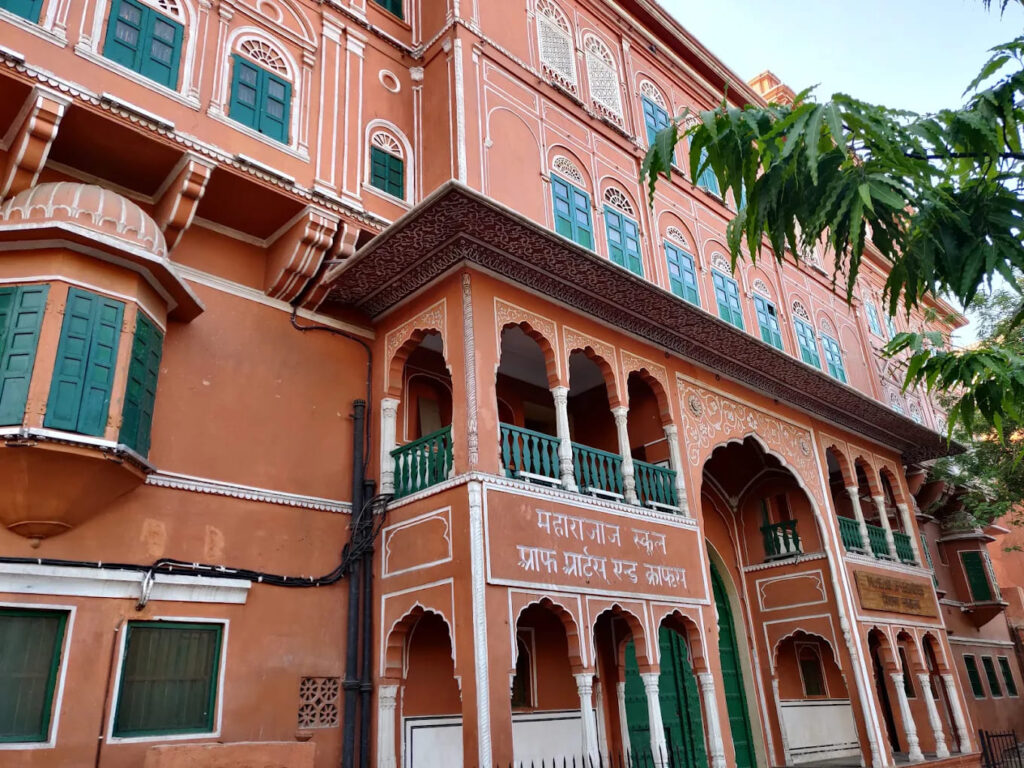
This is the full story of the Maharaja School of Arts and Crafts, where it came from, what it stood for, who built it, and why it still matters today.
Founded: 1857 AD
Founder: Maharaja Sawai Ram Singh II
Original Name: Madarsa-e-Hunari
Renamed 1886: Maharaja School of Arts & Crafts
Current Name: Rajasthan School of Arts
Location: Kishanpol Bazaar, Walled City, Jaipur
Building: Pandit Shiv Deen Ki Haveli (150+ years)
Present Use: Museum of Legacies (Dept. of Archaeology)
The Founding: 1857, and a Maharaja Who Loved Art
Maharaja Sawai Ram Singh II was, by any measure, one of the most progressive rulers Jaipur had ever seen. Born in 1833 and coronated in 1835 at barely two years old, he formally assumed the reins of the princely state as a teenager in the early 1850s, a period when British influence over Rajputana’s princely states was at its zenith. But rather than resisting or retreating, Sawai Ram Singh II engaged with the era’s possibilities with extraordinary confidence.
He built roads and introduced a piped water supply. He established Mayo Hospital. He founded the Maharaja’s School of Art and Crafts in 1857, making Jaipur a centre of learning and cultural advancement. He also built the Maharaja School for Girls in 1867, and it was he who, famously, ordered the pink-washing of Jaipur’s buildings ahead of the Prince of Wales’ visit in 1876, giving the Pink City its defining identity.
The art school was one of his earliest and most lasting contributions. The school was started in 1857 AD, initially with the name “Madarsa-e-Hunari”, the Institute of Arts. In course of time, the institute became a pioneer in the field of art with as many as forty different disciplines of art and craft on its curriculum.
The name itself is revealing. Madarsa-e-Hunari, derived from Persian and Urdu, translates literally as “the school of skill and artistry.” It wasn’t conceived as a finishing school for the elite. It was created to cultivate and preserve the highly specialised craft traditions that Jaipur had been nurturing since the founding of the city itself, when Maharaja Jai Singh II had brought craftspeople from across the subcontinent to populate his new capital.
In the year that India’s first War of Independence shook the British Empire, a Jaipur Maharaja was building something no one else thought to build, a formal school dedicated entirely to the arts and crafts of his people.
The Building: A Haveli With a History Before the School
The building that houses the Maharaja School of Arts and Crafts, and later the Museum of Legacies, has its own layered history, independent of and intertwined with the institution itself.
The haveli originally belonged to Pandit Shiv Deen, one of the most significant figures in the early history of Jaipur’s intellectual and educational life. The museum is housed in a haveli of an important minister in the court of Jaipur, Pandit Shiv Deen. The popular opinion is he donated his residence to the ruling king to be converted into an art school.
This act of donation, a minister gifting his private residence for a public institution, speaks to the close relationship between the court and the city’s cultural life in that era. Pandit Shiv Deen wasn’t simply a bureaucrat; records suggest he was the first principal of the Maharaja’s College in 1844, and had been a tutor to Sawai Ram Singh II himself. The haveli he gave over to the art school was, in every sense, a gift from a teacher to the cause of education.
The building sits in Kishanpol Bazaar, one of the Walled City’s main commercial arteries, named after the Kishanpol gate that opens onto it. The museum is situated in Kishanpol Bazar, one of the prominent bazaars of the walled city area in Jaipur. The museum is run by the Department of Archaeology. The location itself is significant: placing an art school on the main street of a commercial bazaar was entirely in keeping with Jaipur’s foundational logic, where commerce, craft, and culture were always understood as inseparable.
The Architecture of the Haveli
The building is a classic example of Jaipur’s 18th–19th century haveli architecture, characterised by a large central courtyard surrounded by galleries and rooms on multiple levels. The courtyard is the heart of the building, open to the sky, framed by columns and arched walkways, it creates a sense of calm shelter within the busy bazaar outside. There is a mezzanine floor that overlooks the main galleries below, and a staircase that leads to further rooms on the upper floor. The facade facing the street reflects what architectural historians describe as a “new vocabulary” that emerged during the construction, blending the Rajput idiom with influences absorbed from the building traditions of the colonial era.
A School Through the Ages: Key Milestones
1844 – Pandit Shiv Deen Becomes First Principal of Maharaja’s College
The man whose haveli would one day house the art school begins his own career as an educator at Jaipur’s royal college, and serves as personal tutor to the young prince Sawai Ram Singh II.
1857 – Madarsa-e-Hunari Founded
Maharaja Sawai Ram Singh II establishes the Institution of Arts in Kishanpol Bazaar, in Pandit Shiv Deen’s donated haveli. The school is designed to formally train artisans in Jaipur’s traditional craft disciplines.
1876 – Jaipur Goes Pink
Sawai Ram Singh II orders the famous pink-washing of Jaipur’s buildings to welcome the Prince of Wales. The same visionary ruler who built the art school cements the city’s global identity as the Pink City.
1886 – Renamed Maharaja School of Arts and Crafts
The school was renamed the Maharaja School of Arts in 1886, having grown into a pioneer institution with forty disciplines of art and craft on its curriculum. It would carry this name for over a century.
1988 – Renamed Rajasthan School of Arts
The institution is brought under the administrative control of the Directorate of College Education, Government of Rajasthan, and formally renamed the Rajasthan School of Arts.
2018 – Building Reopens as Museum of Legacies
After years of renovation, the historic haveli reopens to the public as the Museum of Legacies under the Department of Archaeology, Rajasthan, a new chapter in the building’s 150-year story of public service.
40 Disciplines of Art: What the School Taught
The most striking fact about the Maharaja School of Arts and Crafts is the sheer breadth of what it taught. The institute became a pioneer in the field of art with as many as forty different disciplines of art and craft on its curriculum. This wasn’t a narrowly focused fine arts academy. It was an institution that treated the full spectrum of Jaipur’s artistic traditions, from the most technically demanding to the most everyday, as equally worthy of formal study.
What were these forty disciplines? While a complete historical record is difficult to compile, we know from Jaipur’s broader artistic heritage that the curriculum almost certainly covered the following traditions that the city was known for:
Painting traditions including the Jaipur school of miniature painting, fresco technique (the style for which Jaipur artists were brought to teach at Visva-Bharati), and the Pichwai style of devotional paintings. Jewellery arts including Meenakari (enamel work on gold), Kundan (gem setting), and Jadau (traditional Rajasthani jewellery making). Textile arts including block printing, bandhani (tie-dye), and embroidery. Metalwork including the brass and copper craft of the Thatheron community. Stonework including marble carving and the creation of jali (lattice) screens. And a range of architectural decorative arts: stucco relief, tile work, and fresco preparation.
The institution was, in essence, a living archive of Jaipur’s entire artistic identity, a place where the city’s crafts were taught, refined, and transmitted to new generations of practitioners.
The Modern Curriculum (Rajasthan School of Arts)
Today the institution, operating from its present campus, continues to offer undergraduate and postgraduate programmes in the visual arts. The school offers various courses including Bachelor of Visual Arts in Applied Arts, Painting, and Sculpture, as well as Master of Visual Arts in Sculpture, Applied Arts, and Painting. There is a library in campus with more than 5,000 books.
BVA · 4 Years – Applied Arts
Commercial and graphic arts, design, illustration, and visual communication.
BVA · 4 Years – Painting
Academic and contemporary painting traditions including classical Indian styles.
BVA · 4 Years – Sculpture
Three-dimensional art-making across materials, including stone, bronze, and mixed media.
MVA · Self Finance – Postgraduate Specialisations
Advanced studies in Applied Arts, Painting, and Sculpture for working artists and graduates.
The school is affiliated with the University of Rajasthan and is the oldest art institution in the state, a distinction it holds not just nominally but in spirit, having been committed to art education since an era when the idea of formal arts education was almost entirely absent from the subcontinent.
Legacy: Why This School Mattered Then and Still Does
It’s worth pausing to understand just how unusual an institution like the Maharaja School of Arts and Crafts was in 1857 India. At that moment, formal art education in the Western institutional sense was largely confined to colonial initiatives in Bengal and Bombay. The idea of a Rajput ruler establishing his own art school, one rooted in indigenous traditions rather than European academic conventions was genuinely distinctive.
Sawai Ram Singh II understood something that many of his peers in princely India did not: that the crafts and arts of Jaipur were an economic resource as well as a cultural one. He established the Maharaja School of Arts and Crafts for the development of art, which is currently known as Rajasthan School of Arts. The artisans who graduated from the school were not simply trained artists they were keepers of techniques that had been imported into Jaipur when the city was founded in 1727, and which represented a concentrated form of artistic expertise found almost nowhere else.
The school’s national significance was recognised far beyond Jaipur. When Rabindranath Tagore established Kala Bhavana at Visva-Bharati in Shantiniketan, he specifically brought in Narasingh Lal, an expert in Jaipur’s fresco tradition to teach there in 1927 and again in 1933. This wasn’t a minor local tradition being exported for curiosity’s sake. Jaipur’s fresco technique was considered among the finest in India, and its practitioners trained at the Maharaja School were its living custodians.
The School and the UNESCO Walled City
When the Walled City of Jaipur was inscribed as a UNESCO World Heritage Site in 2019, the nomination cited the city’s exceptional integrity as an 18th-century planned urban environment but it also placed enormous weight on the continuation of Jaipur’s living craft traditions. The Maharaja School of Arts and Crafts, sitting in the heart of that walled city for over 160 years, has been one of the principal mechanisms by which those traditions have been sustained across generations.
Heritage Adaptive Reuse
The Museum of Legacies: A Third Life for the Haveli
After the Rajasthan School of Arts moved to a new campus, the historic haveli in Kishanpol Bazaar faced an uncertain future. Rather than allow one of Jaipur’s finest 19th-century buildings to fall into disuse, the Department of Archaeology, Government of Rajasthan undertook a careful renovation and repurposed it as the Museum of Legacies. The building reopened in 2018.
Museum of Legacies is a good example of the adaptive use of havelis. The building has been adapted twice ever since it was built for residential use. The first change took place when it was converted into an art and craft school. The second use was when it was turned into a museum. For architecture students and urban heritage enthusiasts, it represents an instructive case study in how historic buildings can absorb new functions across generations without losing their essential character.
The Galleries
The museum is organised across multiple galleries that attempt to capture the breadth of Rajasthan’s artistic and craft heritage. Three main galleries occupy the ground floor, with additional display spaces on the first floor.
🧵 Everyday Embroideries
The largest of the galleries, dedicated to the rich embroidery traditions of Rajasthan. Features textile pieces, durries (woven carpets), and a mezzanine section dedicated to tribal art including Bhil art from Rajasthan, colourful and distinctive in its folk style.
🖼️ Visual Journeys
An art gallery featuring selected pieces including a marble jali inspired by the City Palace ceiling, Gond tribal paintings, and decorative art objects. Some of the pieces curated here are unique and outstanding, including a marble jali made from marble from the Aandhi region in Rajasthan.
💎 Jewellery Gallery
Displays silver jewellery pieces alongside illustrations and photographs of Rajasthani tribals wearing traditional adornments. The gallery covers Kundan, Meena, and Jadau work, three of Jaipur’s most celebrated jewellery traditions.
🎭 Puppets & Pichwai (First Floor)
Houses two giant traditional Rajasthani puppets (kathputli) and a gallery dedicated to Pichwai paintings, the devotional paintings from Nathdwara and their Kota-style variants, traditionally hung behind the idol of Srinath Ji.
Honest Notes for Visitors
The museum is worth visiting primarily for the building itself, the haveli architecture, the courtyard, the carved details, and the sheer weight of history embedded in its walls. The collections, as of last available reports, are modest and somewhat uneven. What it does offer, and what no other institution in Jaipur quite replicates is a direct, physical connection to 165 years of art education history, housed in a building that has shaped the artistic lives of generations of Rajasthan’s craftspeople.
Visitor Information
Address: Kishanpol Bazaar, Near Ajayab Ghar Ka Rasta, Walled City, Jaipur, Rajasthan (Google Map Location: https://share.google/CkE4C5l14jNrgg1b4)
How to Reach: Enter through Ajmeri Gate (Kishanpol Pol) from MI Road. Walk straight into Kishanpol Bazaar, the haveli is on the main street.
Best Time to Visit: Morning (10 AM–12 PM) for the best light in the courtyard. October–March for pleasant walking weather.
Combine With: Chowkri Modikhana heritage walk, Kala Bhawan, Choti Chaupar, and the artisan lanes of Kishanpol area.
FAQ Maharaja School of Arts and Crafts
Who founded the Maharaja School of Arts and Crafts in Jaipur?
It was founded in 1857 by Maharaja Sawai Ram Singh II, the ruler of the princely state of Jaipur. He originally named it Madarsa-e-Hunari (Institute of Arts) and it was created to formally preserve and promote the craft traditions of Jaipur and Rajasthan.
What is the original name of the Maharaja School of Arts and Crafts?
The original name was Madarsa-e-Hunari, a Persian/Urdu term meaning “the school of skill and artistry.” It was renamed the Maharaja School of Arts and Crafts in 1886, and later became the Rajasthan School of Arts in 1988.
Where exactly is the building located?
The historic building, Pandit Shiv Deen Ki Haveli is located in Kishanpol Bazaar in Jaipur’s UNESCO World Heritage Walled City. It is near the Ajayab Ghar Ka Rasta lane, accessible through the Ajmeri Gate (Kishanpol Pol).
What is the building used for now?
The historic haveli was renovated and reopened in 2018 as the Museum of Legacies, run by the Department of Archaeology, Government of Rajasthan. The Rajasthan School of Arts (the institution itself) continues to operate from a separate campus and is affiliated with the University of Rajasthan.
What courses does the Rajasthan School of Arts offer today?
The present institution offers Bachelor of Visual Arts (BVA) programmes in Applied Arts, Painting, and Sculpture, as well as Master of Visual Arts (MVA) programmes in the same specialisations. The school is affiliated with the University of Rajasthan and has a library of over 5,000 books.
Is the Museum of Legacies worth visiting?
Yes, primarily for the building itself. The haveli’s courtyard, architecture, and 150-year heritage are outstanding. The museum collections are modest but include interesting pieces on Rajasthani embroidery, tribal art, jewellery traditions, and Pichwai paintings. Note that collection status may have changed; it’s advisable to confirm with the Department of Archaeology before visiting.
How does the Maharaja School of Arts relate to Pandit Shiv Deen?
Pandit Shiv Deen was an important minister in the court of Jaipur and the first principal of the Maharaja’s College in 1844. He was also a personal tutor to Maharaja Sawai Ram Singh II. He reportedly donated his private haveli in Kishanpol Bazaar to the Maharaja, which was then converted into the art school in 1857.
Why the Maharaja School of Arts and Crafts Deserves More Attention
In a city as visually rich as Jaipur, it’s easy for institutions to be overshadowed by monuments. The Hawa Mahal draws thousands of visitors a day. Amber Fort requires parking logistics. Even Jantar Mantar is on most tourist itineraries. The Maharaja School of Arts and Crafts, tucked into the bustle of Kishanpol Bazaar, wearing the quiet face of a haveli, asks more of its visitors. It asks them to slow down and read between the lines of history.
But what those lines say is extraordinary. A school founded in the year of India’s great uprising. A building donated by an educator to the cause of education. A curriculum of forty arts and crafts at a time when most of the world hadn’t conceived of formal craft education. A legacy that reached from this lane in the Walled City all the way to Tagore’s ashram in Bengal, where a Jaipur fresco master was brought to teach. And a building that has now outlasted three distinct uses: haveli, school, museum, each one layering new meaning onto the old.
If you are visiting Jaipur and you have even an afternoon to give to something off the usual trail, walk through Ajmeri Gate into Kishanpol Bazaar. Find the haveli. Step into the courtyard. Stand where generations of Rajasthan’s artists once learned their craft. That is a kind of heritage that no palace wall or royal cenotaph quite captures, the heritage of making things, and of teaching others to make them.