
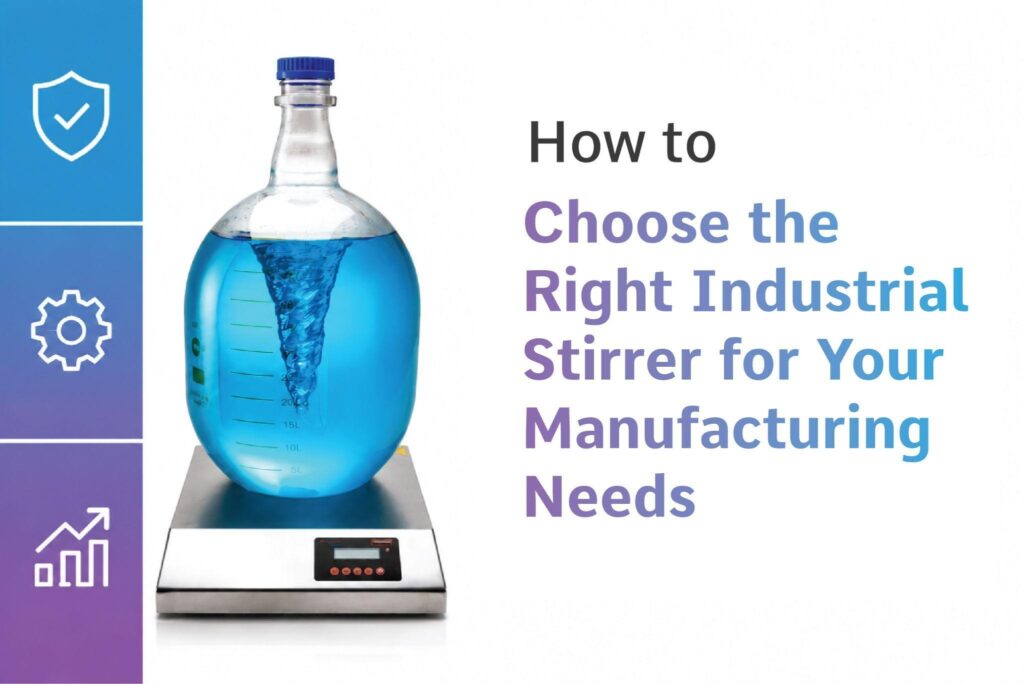
Industrial stirrers play a vital role in supporting consistent production quality across pharmaceutical, biotech, and chemical manufacturing. In regulated environments, choosing the right stirrer helps ensure smooth operations, batch uniformity, and alignment with compliance standards. Key considerations include volume capacity, magnetic coupling strength, digital control features, plate material, and how efficiently the unit handles varying viscosities. A well-informed, technically sound approach ensures long-term efficiency and readiness for audits in GMP-focused facilities.
Industrial vs Standard Magnetic Stirrers: What’s the Difference?
Standard magnetic stirrers are commonly used for analytical prep work, low-viscosity media, and smaller volumes. They are compact and suitable for routine liquid mixing.
Industrial stirrers, by contrast, are designed for larger batch sizes, often up to 100–150 litres, and for handling low to medium viscosities with stable rotation. Their magnetic coupling systems deliver stronger drive force, allowing them to maintain stirring without decoupling even when the load increases.
| Parameter | Standard Magnetic Stirrers | Industrial Magnetic Stirrers |
| Volume Range | 50 mL – 20 L | 10 L – 100/150 L |
| Viscosity Range | Low | Low to medium |
| Magnetic Drive | Basic coupling | High-strength coupling |
| Heating | Common | Robust heating integration |
| Surface Material | Ceramic / SS | Chemical-resistant ceramic preferred |
What are the key requirements of an Industrial Stirrer?
1. Magnetic Coupling Strength and Speed Stability
In industrial-scale applications, the stir bar must remain engaged even as viscosity or volume increases. Instead of torque from a mechanical shaft, the primary performance factor is magnetic coupling strength and the unit’s ability to maintain RPM without drop-off.
Essential parameters include:
- Stable speed range, typically around 50–1000 RPM
- Digital RPM control for precision and repeatability
- Closed-loop regulation, where the system adjusts power to maintain a set RPM under load
- Soft-start functionality to prevent splash and avoid bar decoupling
These capabilities help ensure consistent performance during processes where viscosity may change across the batch.
2. Choosing the Correct Unit Based on Vessel and Setup
Since industrial magnetic stirrers do not use shafts or impellers, proper selection focuses on:
- Plate size relative to vessel diameter
- Stir bar length and shape for optimal circulation
- Chemical-resistant housing that supports compatibility with glass, stainless steel, or jacketed reactors
- Stable, non-slip footing to support large vessels
For deeper vessels, using an elongated, high-strength stir bar helps promote vertical mixing and prevents dead zones.
3. Digital Monitoring Features are More Than Just a Display
In regulated environments, stirring systems must offer repeatability, traceability, and calibration support. Features that enhance reliability include:
- Digital RPM display for exact run-to-run replication
- Timer settings for automated process control
- Temperature monitoring when used with integrated heating
- Safety cut-off mechanisms to prevent overheating or magnetic decoupling
Advanced units may also provide PID-controlled heating, supporting thermal uniformity essential for reproducible results. Digitally enabled manufacturers like Borosil Scientific integrate digital RPM feedback, stable speed regulation, and built-in safety cut-offs to support consistent and traceable operations.
4. Heating Considerations: Hotplate Stirrers and Jacketed Systems
Industrial magnetic stirrers are often paired with:
- Ceramic hotplates for acid-resistant, uniform heating
- Stainless steel surfaces for rugged, general-purpose use
- Jacketed vessels, where the stirrer supports consistent mixing while external heating or cooling maintains reaction temperature
When using hotplates, ensure:
- Even heat distribution
- Plate material compatible with your media
- Temperature accuracy within a narrow range—for example, a ±1°C PID window for critical formulations
5. Viscosity and Batch Size: Matching Specifications to Application
Choosing an industrial magnetic stirrer based solely on price can lead to premature equipment stress or inconsistent mixing. Always cross-check your batch characteristics with the unit’s capabilities.
| Application | Viscosity | Volume | Recommended Stirrer |
| Media Prep / Buffer Solutions | Low | 10–50 L | Industrial magnetic stirrer |
| Nutraceutical Suspensions | Low–Medium | 25–100 L | High-coupling industrial magnetic stirrer |
| Solvent Mixing for Scale-Up | Low | 50–150 L | Large-capacity magnetic stirrer |
| HPLC Mobile Phase Prep | Low | < 2 L | Standard magnetic stirrer with heating |
If working with volatile solvents or processes involving evaporation, consider vessel lids or condenser integration to maintain volume accuracy.
6. Safety, Maintenance, and Durability
High-quality industrial magnetic stirrers prioritise:
- Overload protection to prevent interruption or overheating
- Sealed housing to guard internal components from splashes
- Chemical-resistant ceramic surfaces for long-term durability
- Easy-to-clean designs for efficient turnaround between batches
Since these systems rely on magnetic drive components rather than mechanical shafts, maintenance requirements remain minimal, supporting high uptime. Leading manufacturers like Borosil Scientific focus on durable housings, chemical-resistant surfaces, and designs that support easy cleaning, making them suitable for high-usage laboratory environments.
Conclusion
For pharmaceutical R&D, formulation development, and batch manufacturing, the right industrial magnetic stirrer should provide not only sufficient power for large volumes but also the digital control, stability, and safety features required in regulated facilities. While standard magnetic stirrers are suitable for smaller, low-viscosity tasks, industrial-grade units are essential for medium-volume workflows that demand reliable magnetic coupling, consistent heating, and process traceability.
Premium manufacturers like Borosil Scientific offer features such as high-strength magnetic drives, chemical-resistant surfaces, digital RPM feedback, and stable platforms designed for large vessels. These capabilities support SOP adherence, reproducible results, and long-term operational efficiency. Choosing the right system adds value to every batch, while an underpowered or unstable one introduces unnecessary risk.